
Posts

Understanding Reading Problems Using the Reading Rope

Your child can read every word on a page but struggle to tell you what it means. Or they may explain a story beautifully when you read it aloud yet have trouble reading it themselves. How can both be true?

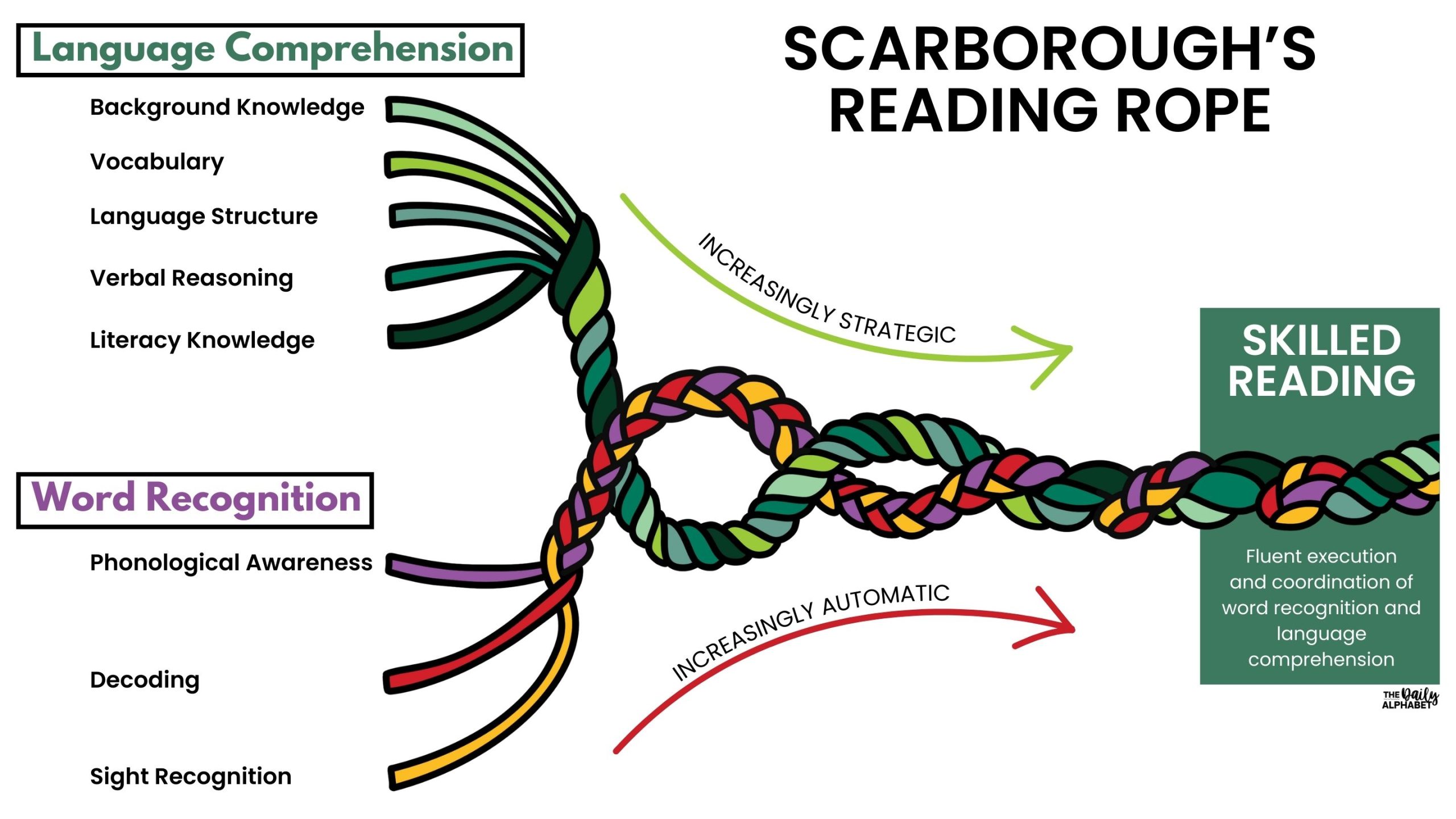
Scarborough’s Reading Rope offers a helpful picture. Imagine many small strands woven into one strong rope. Skilled reading depends on two groups of strands working together: word recognition and language comprehension.

Recognizing the Words

These strands help a child notice sounds in spoken words, connect letters to sounds, sound out unfamiliar words, and eventually recognize familiar words quickly. When identifying each word takes a great deal of effort, a child has less attention available for the meaning of the passage.

Comprehension: Understanding the Message

These strands include vocabulary, background knowledge, understanding sentences, making connections and inferences, and knowing how stories and other texts work. A child may read words accurately but still need support understanding what the words mean together.

What Can You Do?

Notice where reading becomes hard. Does your child struggle to read the words, explain what they read, or both? Ask the teacher what they notice, too.

Keep sharing books and conversation. Reading aloud, discussing new words, and talking about your child’s interests help build language and knowledge, even while they are learning to read independently.

Ask about the right kind of support. If sounding out words is difficult, ask how the school is teaching and checking word-reading skills. If understanding is the concern, ask about vocabulary, background knowledge, and comprehension. Some children need support in both areas.

From a school neuropsychologist’s perspective, the rope is a reminder to look closely at a child’s pattern of strengths and needs. A reading struggle does not tell us how capable a child is. It tells us which strands deserve attention and where the right support can help.

Here’s An Example

Imagine your child reading The Magic School Bus Inside the Human Body, in which Ms. Frizzle’s class travels through Arnold’s body. Your child may love the illustrations and eagerly explain what happens to the bus when you read the book aloud but struggle to read words such as stomach or bloodstream independently. That suggests their understanding is a strength, while word recognition may need support.

Another child may read those words smoothly but have trouble explaining what the stomach does or why the bus moves through different parts of the body. For that child, language comprehension, including vocabulary and background knowledge, needs more attention.

Both children are curious about the same book. Scarborough’s Reading Rope helps us ask a more useful question than “Is my child a good reader?” It helps us understand which part of reading is working well, and which strand needs support. Once identified, you can hire a reading specialist to target that area and provide support.

Testing Provides Specific Answers

Our testing can help you identify which part of your child’s reading is not working so you can provide specific support rather than taking a general, “I hope it helps” approach. Call (561) 625 4125 to discuss helping your child. We test for dyslexia, ADHD, autism, learning disabilities, processing problems, and more. JimForgan.com.

Four Ways to Approach Your Child’s Reading Problems

Your child’s reading problems are real life problems since reading is required in all school subjects.  The percentage can vary depending on the specific definition of “reading problems,” but approximately 20% of children have reading problems. This includes conditions like dyslexia and other reading difficulties. There are four ways to approach your child’s reading problems.

First Approach

The least favorable approach is a wait and see approach. Some parents are told statements such as, “Give it more time and she’ll catch on soon.” or “Boys are just slower to read than girls.”  Well intentioned advice can actually cause your child considerable setback.  Kindergarten through second grade is when children concentrate on learning to read but from third grade onward children must read to learn.  Hence, mandatory third grade retention if your child does not pass the high stakes reading testing.

Second Approach

A second approach is for you to work with your child at home. While you might not be a professional teacher, you can teach your child to read by purchasing reading materials.  One parent book is Teach Your Child to Read in 100 Easy Lessons.  You might require your child to use reading websites such as ABC Mouse, Starfall, Raz-Kids, or Nessy. These supports help many children learn to read.

Third Approach

Many parents hire a tutor as a third approach to reading struggles. I recommend one-to-one reading tutoring as the best way to make reading gains.  There are plenty of teachers tutoring after school at libraries, homes, and businesses.  Most schoolteachers tutor use an eclectic approach to teaching reading.

Fourth Approach

Call for school neurological testing when your parental instinct is telling you your child’s struggles are more than developmental and might be dyslexia. In this approach we test for dyslexia and other learning disabilities.  Our testing pinpoints exactly what is causing the struggle so you can provide targeted support rather than try and see support. If it is dyslexia, Florida gives parents money to help with tutoring costs.

Call (561) 625 4125 if you would like to discuss your child’s reading problems or concerns for dyslexia, ADHD, autism, or anxiety.

Identifying Early Reading Struggles

Identifying Early Reading Struggles

Ask any elementary school teacher and they will confirm that many kids struggle with reading.  School staff do their best to help with limited resources but many take a wait and see approach.  Waiting does not benefit your child.  As an astute parent or family member, follow your instinct to determine the root cause of your child’s reading struggle.

Students who struggle with reading in the early grades will eventually struggle with all academic areas. This occurs because the curriculum in upper grades relies more and more on independent reading skills. In fact, research studies have shown that it is important to assess and remediate a child’s reading skills at an early age. Researcher Joseph Torgesen and colleagues documented that more than 80% of students who were poor readers at the end of first grade still performed below average at the beginning of third grade.  Don’t let your child become a reading failure statistic. Specialized reading help is available when you have the right knowledge.

Keys to Helping

The keys to helping your child include following your hunch, seeking an expert to test your child to determine which reading program is best for your child’s needs, and using the program with an experienced professional.  The correct reading program can help save time, stress, and create life changing gains within your child.  We encourage you not to accept a one size fits all reading approach offered by many schools.

Since Dr. Forgan is also a Susan Barton certified dyslexia tester, we use unique tests that others don’t have.  Within a few weeks we give you answers and tell you the best reading program we believe will help your child.

Call to discuss your child as we test students ages 5.5 through college for dyslexia, learning disabilities, ADHD, depression, anxiety, and other processing disorders.  Call (561) 625 4125

Three Ways to Give the Gift of Reading

Give the gift of reading to your child this holiday season.  Many elementary age children struggle with reading and COVID-19 and virtual learning have widned the gap.  In addition, if you were your child’s teacher during the lock down, you saw first-hand how hard reading was for your child.  Since reading is foundational for academic success, your child’s reading needs to be on or above grade level.  Here are three ways you can help improve your elementary age child’s reading.

Gift Number 1

First, use the computer based reading program Nessy at Nessy.com. This reading program is for children in kindergarten through fifth grade and it is based on Orton Gillingham reading principles.  Nessy helps children with dyslexia as well as children with weak phonics.  It has built in assessments, adjusts to your child’s reading level, and provides games and characters as rewards.  I recommend using the Nessy program 4 days per week.  It’s not free but is reasonably priced at $12/ month or less if you purchase annually.

Gift Number 2

Next, you can teach your child using a specialized reading approach.  The Barton Reading and Spelling System was designed for parents and educators to use one-to-one with children.  To use the program you should first take and pass the tutor screening.  Then purchase levels from BartonReading.com.  Each level comes with training on DVD so you can watch the training and then use the program with your child.

Gift Number 3

Third, make reading fun.  Struggling readers find reading laborious and mentally draining so they don’t want to pleasure read.  Regardless of their age, read aloud to your child.  This builds vocabulary and keeps the love of reading alive.  As an alternative use Audible or Bookshare.com and listen to an audio book together.  Young kids enjoy graphic novels like the “Dog Man” series.  Use the book “Create Your Own Graphic Novel: A Guide for Kids” by David Chiu to work with your child and create your own graphic novel.  This provides a fun way to read, write, and draw.  Who knows, your child could become a bestselling author.

We offer dyslexia and ADHD/ADD testing so call 625-4125.

When Jacob Can’t Read

There is a major problem when ‘Jacob’ can’t read and is in the first grade or higher. If your son, daughter, or grandchild is 6 or older and can’t read get it checked out. This advice assumes your child has at least average intelligence, attends school, and receives adequate instruction. At this young age the timing is critical so don’t let anyone tell you to wait and see or just give ‘em more time. I can evaluate your child to determine the best reading program to teach him or her.

My son was fortunate that I knew the warning signs to look for because in kindergarten he struggled to learn to read. He attended preschool, had a good kindergarten reading teacher, and we worked together at home, but he just could not seem to unlock the reading code. The traditional way of learning to read did not work for him. I paid a certified Orton-Gillingham based multisensory reading tutor to begin teaching him twice a week using this specialized method. It did wonders and he learned to read and now as a middle school student reads like a pro. My family and I are forever grateful to Mrs. Johnson for her skill in helping teach him to read. The testing and tutoring were great investments for his future success.

These are some warning signs to look for in young children: speech problems, slow reading, knowing a word in one sentence but not the other, difficulty sounding out words, and poor everyday spelling. Warning signs in older students include: does not enjoy reading, difficulty remembering what was read, difficulty telling important from unimportant details, spells poorly, and when speaking, may have difficulty finding the correct word. These warning signs often get worse with age. I can evaluate children for reading problems as young as age five and a half.