
Posts

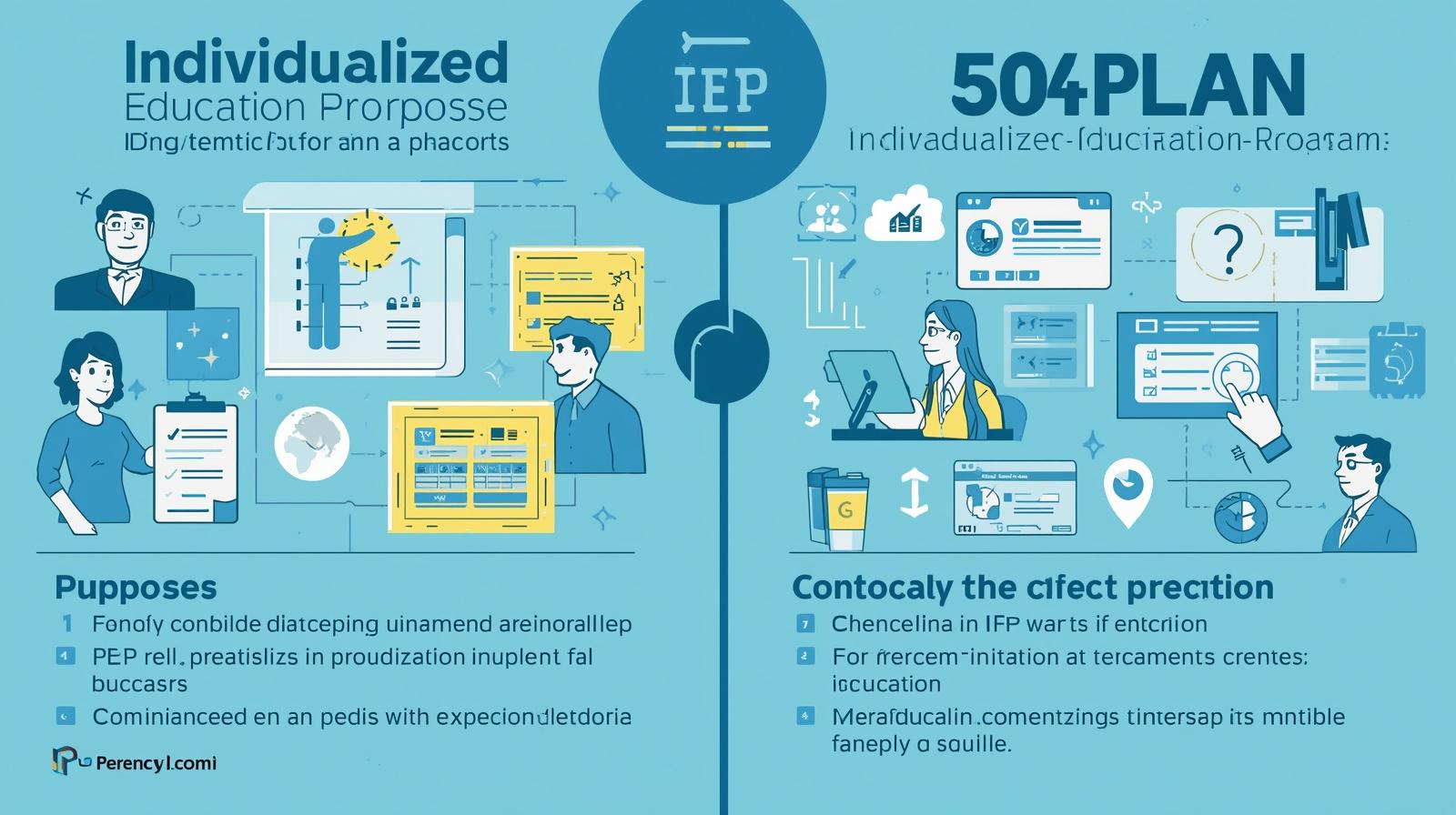
IEP or 504 Plan

If your child receives special education services then they have an IEP. While the federal legislation called Individuals with Disabilities Education Improvement Act (IDEIA or IDEA, 2004) spells out the rules and regulations for students who are placed in special education settings, and have an IEP; the Rehabilitation Act of 1973, specifically Section 504, describes rules to protect students from discrimination because of their differences. When a student gets to college, it is Section 504 that ensures that they won’t be excluded from college because they cannot meet the SAT requirement because of their learning disability. It also ensures that an individual will not be discriminated because of chronic illness when they apply for a job. However, Section 504 also has an impact on education in grades k-12 too.

A 504 plan is a legal document that describes an instructional plan for children with disabilities when they are in the general classroom. The 504 plan focuses on the “reasonable” accommodations and modifications that will support the child’s learning. In practice, students with IEPS (like SLD or ASD) also need accommodations and modifications. However they do not also have 504 plans, as their IEPS contain the accommodations and modifications that are needed. IDEA requires specific criteria for each disability, Section 504 of the Rehabilitation Act doe s not. Therefore, the Rehab Act is more global, indicating only that the child/adult has to have an impairment of one of the systems of the body (skeleton, neurological, sensory, respiratory, etc). So a 504 plan may be developed for a student identified with AD/HD, ADD, Asthma, Diabetes, Cystic Fibrosis, Bipolar Disorder, or many other chronic illnesses. The 504 plan provides strategies and direction for the general classroom teacher. The strategies are not very different from those used in IEPS, it is just that they are provided in the general class environment.

Tools for Teens With ADHD

If your teenager has Attention Deficit Disorder or Attention Deficit Hyperactivity Disorder (ADD/ADHD) then you know your child needs to learn tools for independently living so you stop calling him or her disorganized, unmotivated, lazy, only interested in select interests, or a procrastinator.  I’m a big believer that books can help parents and teens learn new tools for improving their circumstances.

I came across a recently published book called The ADHD Workbook for Teens: Activities to Help You Gain Motivation and Confidence. Consider using this book to empower your adolescent with ADHD.  There are 40 applied activities you and your teen can complete.  A couple of activities are corny but most are pretty helpful and spot-on.  One of my favorites was “Pushing Back Against Your Cant’s” and I believe in this activity because so many teens with ADHD have a pessimistic and negative outlook.  These teens often experience ANTS or automatic negative thoughts that spring up and push down.  The book’s activity helps teens learn to combat and replace the ‘can’t’ mindset with a ‘can’ mindset.  Being able to have and keep a positive mindset is an important skill for success in life.

Using books to help your teen is a natural way to change his or her mindset or outlook.  If your adolescent has a negative perspective they are not alone and this perspective does not go away without help.  The help can come from counseling or books.  Decide which one works best for your teen and start him or her on a new path to reach his or her full potential.

When Should You Stop ADHD Medication?

Many parents grapple with the question, “Should I start my child on medication?”  but just as many parents also wonder when they should stop medication.  Some children will need to be on medication throughout their childhood and adolescent years. Other kids may be on medication throughout this time but, if their medication allows it, take holiday breaks such as weekends, summer, and extended breaks.  There may come a point where your child or teenager says, “I don’t want to take this medication anymore.”  Can you force him or her to take the medication?  This often becomes a battle that many parents face.

Ask yourself this question. Are my child’s grades satisfactory? If your child’s grades are satisfactory than he or she may not need the medication. Ask yourself this question. Is my child continually getting in trouble? If the answer is no, it may be time for a medication break.  Many parents are concerned that if their child stopped taking the medication their behavior will worsen for their grades will slip. Yet, at what point does the child need to start taking responsibility for their behavior and work? The pills don’t replace the skills that your child needs to be successful. If you stop the medication you may have to provide some tutoring or coaching to help your child learn the skills.

As parents we need to provide the support our children need. If they need the medication than continue it but if your child is asking for a break you believe he or she is ready for the responsibility that perhaps it’s time to stop the ADHD medication.

25 Ways to Help Your Teen with ADHD

Some teens struggle socially and teens with ADHD must have good people skills in order to live life to the fullest.  After all, building relationships is one of our primary functions as a human being.  In order to help your teen I recommend using the book 25 Ways to Win With People, by Drs. John C. Maxwell and Les Parrott.  It’s packed with practical ways to build relationships.  The writing is readable and not at dense or technical. It includes many stories to illustrate the 25 key points.  And the book is small.  It won’t overwhelm teens that are immediately turned off by thick, textbook-style volumes.  I encourage parents, grandparents, aunts, uncles and important adult friends to read the book ahead of time, or together with the teen. This allows for important common grounding. In other words, everyone has the same information. That opens the way for discussion and shared experiences or ideas. How might your family work this valuable book into your routine? There are two ways you might do so:

Save this book for summer reading, when the academic demands of school lessen.  Read the book in advance, and let your son know that over the summer he’ll be reading an excellent and potentially life-changing book called 25 Ways to Win With People. For the first 25 weekdays of summer, he’ll read a chapter a day. Reassure him/her – the chapters average less than seven pages. It will take five weeks to complete the book. Each day, you’ll ask him/her to write a short summary of the key point and discuss it with you.  Role-playing is another effective practice tool. You can practice these new skills within the supportive context of your home, where he/she shouldn’t be as self- conscious as he/she might in public. 

 Make learning and applying the 25 points a family project. Together, the family agrees to read one chapter per week. Some parents set aside part of the day on Saturday or Sunday to have a short talk about the key point. For the entire week each family member works on applying the step. Family members practice with each other as well as out in their school, work, or daily activities. If the family has dinner together, they should talk about their experiences.  

Even though a new point is introduced each week, it’s important to keep in mind that earlier points don’t get discarded. Apply them as much as possible, especially if there are one or two you have found highly useful. This is what I call the “rent to own” philosophy.  We are teaching our teenagers to try the point out (or rent it) for a week.  If he/she finds it useful, he continues to rent it and use it. At some point your teen may decide that this point is so helpful that they’ll decide to own it and apply it on their own, because he/she has recognized its value in his/her life. 

 Think about your family and decide which way would work best for you.  Your teen will soon have 25 ways to become more successful with people.

Prevent Being Held Back

Be proactive.  If you suspect your child may have learning or behavior issues at school, contact me.  I find that most moms are very intuitive about their children so trust your instincts.  My advise to you is don’t take a wait and see approach.  Time is too valuable as there are only five months of school remaining and FCAT testing is close.  Historically, school districts move slow when supporting kids that struggle. 

The results of my evaluation will identify your child’s strengths and weaknesses.  I make sure to tailor the evaluation to answer your specific questions!  It is accepted by public and private schools.  This documentation can speed up the help your child receives in school.  Without written documentation, your child’s school won’t usually make any adjustments.  These are called reasonable accommodations and they are required by law if your child has a learning disorder.  There is still time to give your child an academic boost to get through the school year.

A proactive investment in your child’s future can save you from wasting your money on hit and miss search for answers.  Your child’s school can give extra help and support if you have the proper documentation.  Answers await you.  Don’t wait for your child to fail before getting help.  Your child will thank you and you’ll have peace of mind.