
Posts

Overcoming Reading Problems Using the Reading Rope

Your child can read every word on a page but struggle to tell you what it means. Or they may explain a story beautifully when you read it aloud yet have trouble reading it themselves. How can both be true?

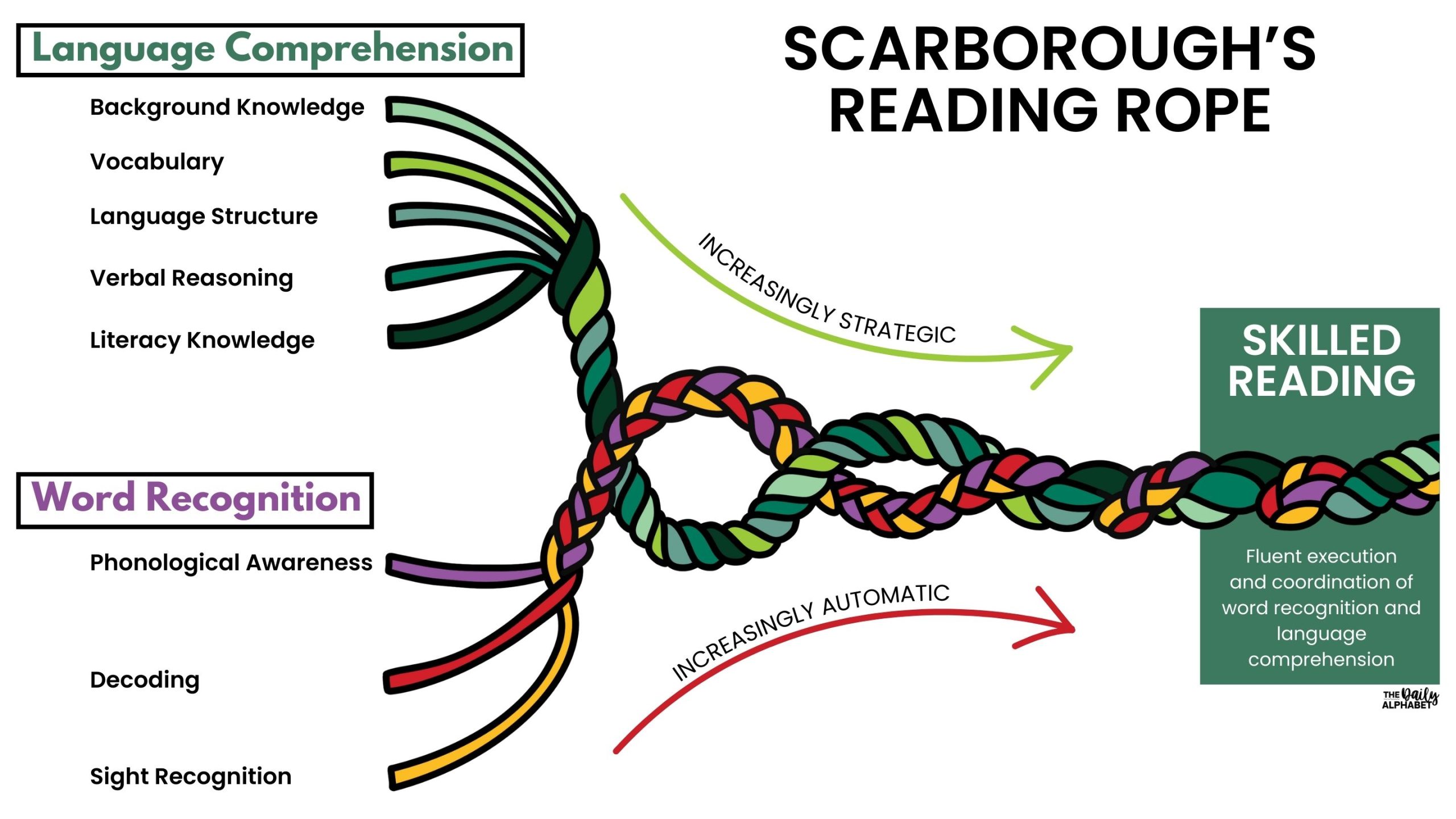
Scarborough’s Reading Rope offers a helpful picture. Imagine many small strands woven into one strong rope. Skilled reading depends on two groups of strands working together: word recognition and language comprehension.

Recognizing the Words

These strands help a child notice sounds in spoken words, connect letters to sounds, sound out unfamiliar words, and eventually recognize familiar words quickly. When identifying each word takes a great deal of effort, a child has less attention available for the meaning of the passage.

Comprehension: Understanding the Message

These strands include vocabulary, background knowledge, understanding sentences, making connections and inferences, and knowing how stories and other texts work. A child may read words accurately but still need support understanding what the words mean together.

What Can You Do?

Notice where reading becomes hard. Does your child struggle to read the words, explain what they read, or both? Ask the teacher what they notice, too.

Keep sharing books and conversation. Reading aloud, discussing new words, and talking about your child’s interests help build language and knowledge, even while they are learning to read independently.

Ask about the right kind of support. If sounding out words is difficult, ask how the school is teaching and checking word-reading skills. If understanding is the concern, ask about vocabulary, background knowledge, and comprehension. Some children need support in both areas.

From a school neuropsychologist’s perspective, the rope is a reminder to look closely at a child’s pattern of strengths and needs. A reading struggle does not tell us how capable a child is. It tells us which strands deserve attention and where the right support can help.

Here’s An Example

Imagine your child reading The Magic School Bus Inside the Human Body, in which Ms. Frizzle’s class travels through Arnold’s body. Your child may love the illustrations and eagerly explain what happens to the bus when you read the book aloud but struggle to read words such as stomach or bloodstream independently. That suggests their understanding is a strength, while word recognition may need support.

Another child may read those words smoothly but have trouble explaining what the stomach does or why the bus moves through different parts of the body. For that child, language comprehension, including vocabulary and background knowledge, needs more attention.

Both children are curious about the same book. Scarborough’s Reading Rope helps us ask a more useful question than “Is my child a good reader?”: Which part of reading is working well, and which strand needs support? Once identified, you can hire a reading specialist to target that area and provide support.

Testing Provides Specific Answers

Our testing can help you identify which part of your child’s reading is not working so you can provide specific support rather than taking a general, “I hope it helps” approach. Call (561) 625 4125 to discuss helping your child. We test for dyslexia, ADHD, autism, learning disabilities, processing problems, and more. JimForgan.com.

When Kids Hate Themselves

My first grader can’t read and has recently said, ” I hate myself” because she doesn’t feel smart. She says things are too hard and I can see her getting discouraged. She has trouble remembering letters, sounds, some numbers. She can’t keep up with everyone. Her teacher says she is the lowest one in her class.”

What to Do?

This concerned parent’s description of her child cried out for help and understanding. It is highly unusual for a young student to make statements such as they hate themself, they feel dumb, or they want to die.  No student wants to go to school and repeatedly fail. Furthermore, it is a giant red flag when your child’s teacher says your child is the lowest one in the class.  Given these challenges, this young child’s self-esteem is at risk of long-term damage.

As a concerned parent, you can provide your child with support and understanding. If you suspect an underlying learning disability like dyslexia, our school neuropsychological testing provides answers.  We also test for processing problems such as a weakness in phonics development and memory. Once you understand the specific problem you can then provide the right treatment to help.

Individual Testing

The testing revealed this child had phonological dyslexia with anxiety.  Her mom followed up with one of the specialized tutors and started three times a week tutoring.  Once she received our written report, the teacher helped get the child an IEP for school support. The IEP allowed the school’s special education teacher to work with her in addition to her private tutoring. Parents used children’s books to help with her anxiety of being embarrassed for her reading struggles.  In a follow up conversation, mom said she had renewed hope for her child’s future.

Ages 2 Through College

We test students from age two through college for dyslexia, ADHD, anxiety, depression autism, and more. Call us at (561) 625 4125 to discuss your child or learn more at www.JimForgan.com.

Helping Poor Readers

It can frustrate you and your child when reading does not develop easily.  Sometimes the struggle becomes a blame game of blaming the child for not trying hard enough, blaming a teacher for poor teaching, or even blaming yourself for not spending enough time reading with your child.  Ultimately, a child’s struggles are often related to a combination of factors including a genetic predisposition for reading difficulty.  Many times learning disabilities such as dyslexia occur within the family tree.

Helping Poor Readers

To help your child you have many choices of doing testing, tutoring, brain training, waiting, or talking with the teacher.  While testing and tutoring are preferred, the one thing I recommend you do is not let your child lose the hope that they can become a great reader.  When I test poor readers I identify the root cause and most effective reading program to help your child make the most improvement as fast as possible.  I also assess self-esteem as some kids come in feeling defeated and believing they have a broken brain.

Reading Interests

I understand the struggles because I had a hard time reading and sounding out words but I had a strong memory so I could compensate and memorize words well.  During my childhood it was common to collect things so as a 10-year-old kid I collected beer cans. I my dad drank the beer and I displayed the can’s colorful design.  My parents subscribed me to Beer Can Collectors of America and I read articles about beer cans. We went on the brewery tour at Busch Gardens.  While these did not lead me to my career, the activities motivated me to read.

You might encourage your child to read about his or her interests in Pokémon, Minecraft, arts and crafts, or Candy Crush.  Support your child’s reading interests with material and experiences.

Special Reading Support

To help poor readers, start with specialized tutoring at reading centers like Lindamood Bell or the Reading Success Center in Palm City. I have some specialized reading tutors at JimForgan.com/tutor.  If money is tight, you teach your child using the Barton Reading System at BartonReading.com.  Reading is a skill so it can improve.

If you suspect dyslexia, call our office as we test children ages 5.5 through college for dyslexia, ADHD/ADD, gifted, and other processing disorders.  Call (561) 625 4125.

Warning Signs of Dyslexia and Reading Problems

If you are concerned that your child’s reading is not developing appropriately, see if they have any of these warning signs of a learning disability like dyslexia.  This is important because children as young as age 5 can be identified as either at risk for, or having, a reading disability.  If your child has three or more of these warning signs, learn more about identifying and overcoming reading problems.

These are some of the preschool age warning signs of possible reading problems: delayed speech, mixing up the sounds and syllables in long words (psgetti, aminal), numerous ear infections, trouble memorizing letters or the alphabet, and can’t create words that rhyme.  Many preschoolers with speech problems also have reading difficulty.

Elementary age warning signs of reading problems include: letter reversals, slow choppy reading, guesses based on shape, ignores suffixes, skips or misreads prepositions (at, to, of), or difficulty sounding out unknown words. Other warning signs include difficulty telling time with a clock with hands as well as trouble memorizing math facts or a sequence of steps. 

Middle and high school warning signs can include the above plus a limited vocabulary, poor written expression compared to speaking skills, difficulty learning a foreign language, and poor grades.

Depending on your child’s age there are many effective reading programs.  Having your child evaluated can help determine the most effective program.  This way you don’t spend your valuable time and money on a hit and miss approach of things that don’t work well.  With a proper evaluation there are many school supports available.  The important point is not to let things drag on hoping they will improve.   Check it out so you can have a focused plan and don’t waste time doing a hit and miss approach.

Can Books Help Children?

The motto of my practice is “Helping Parents Help Children.”  One way I believe parents can help their children is to increase our own knowledge about how kids think, feel, and act.  I want to share two books that my wife and I have found helpful in raising our son and daughter.  I think they can help you too.  One book is for fathers and the other is for moms.  Both are easily available online or in most bookstores because books help children.

One of my favorite books for dads is called “The Difference A Father Makes” by Ed McGlasson.  Ed is a former NFL star and played football for the Raiders.  His small book is a quick, but meaningful, read that helps fathers understand the importance of their power in preparing our children for life.  He shares personal examples of how he influenced his sons and daughters to become leaders in life.  This includes an awesome chapter called Rites of Passage that has information to give fathers the power to change his relationship with his son or daughter forever.

The book I recommend for moms is called “That’s My Son: How Moms Can Influence Boys to Become Men of Character” by Rick Johnson.  My wife found this book helpful because she grew up with two sisters and no brothers.  She did not have family experiences as a child learning what makes boys tick.  By reading Rick’s book she found a new understanding about our son.  The book is appropriate for single moms as well as married moms.  There are some interesting secrets in this book that Rick tells about the inner workings of boys.  He gives moms straightforward honest advice to help moms discuss communication, respect, and learning self discipline.

I believe books can be valuable tools in helping parents build stronger relationships with their children and these two books are a great starting point.  If your child struggles in school, dislikes school, is easily frustrated with homework, or has other school issues, consider getting him or her evaluated.  My evaluation process can help reveal the true issue so that you can begin the appropriate intervention instead of trying a hit and miss approach.  It’s an investment that can get your child on the right track.

Dr. Forgan is a Diplomate of the American Board of School Neuropsychology and certified dyslexia testing specialist who can evaluate your child for ADD/ADHD, giftedness, dyslexia, and other associated disorders.  Call 625-4125 to discuss your child.