
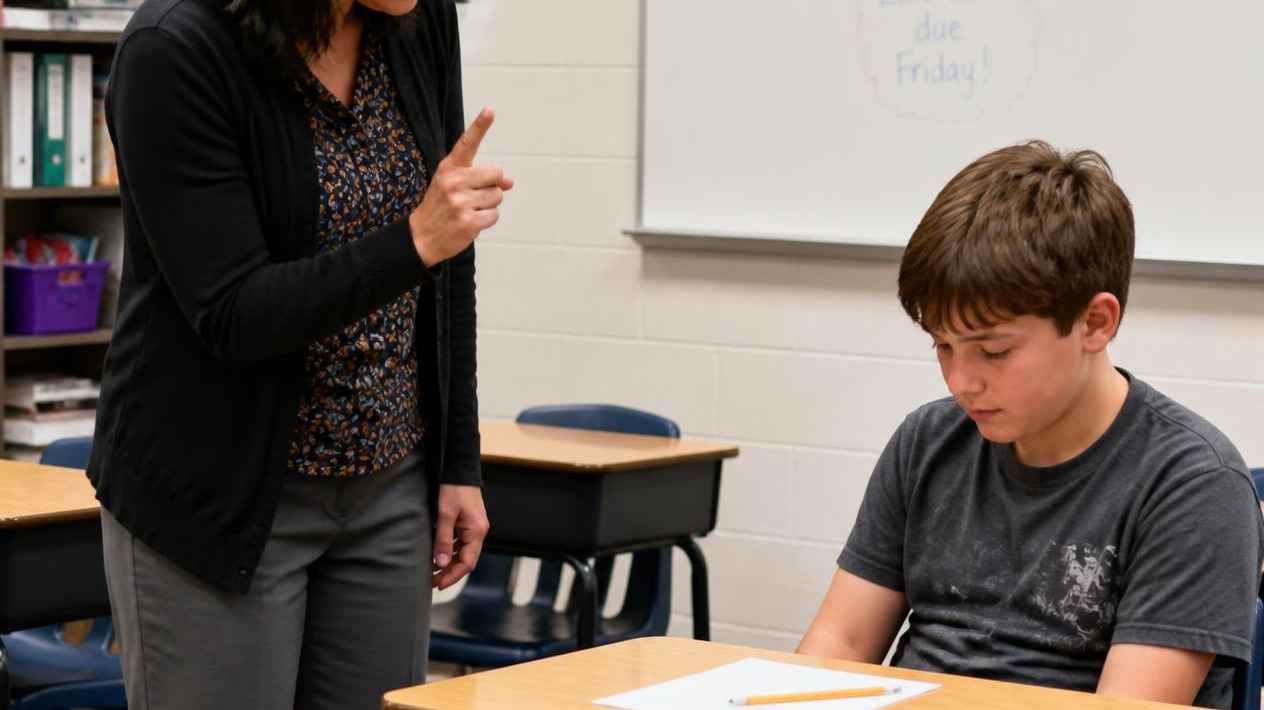
Help Me! My 11-Year-Old Continually Has Behavior Problems at School
This parent’s cry for help is often what brings families to us for school neuropsychological testing. It’s very uncommon for an 11-year-old to continually have behavior problems at school.
The parents told me, “My 11-year-old son is impulsive, disruptive, and frequently off task at school. He struggles to make friends and does not seem to read the room. He sometimes denies things that happened and repeatedly engages in the same behaviors, even after consequences. What could be wrong with him?”
When a child repeatedly experiences behavioral and social problems, you naturally want an explanation. You may wonder whether your child is being defiant, dishonest, immature, or simply making poor choices. However, behavior is often a form of communication. Instead of asking only, “How do we stop this behavior?” it can be more helpful to ask, “What skill is he missing, and what is making this situation difficult for him?”
These parents had already been to see their pediatrician who told them this was complicated and recommended us for a school neuropsychological evaluation. When the parent came to us, we discussed that several possibilities need to be explored.
ADHD and Executive Functioning Weaknesses
Impulsivity, difficulty staying on task, excessive talking, interrupting, and repeating behaviors despite consequences can be associated with ADHD. Children with ADHD may understand a rule when it is explained but have difficulty applying it in the moment. Weaknesses in executive functioning can affect your child’s ability to pause, consider the consequences, regulate emotions, remember expectations, and change course after receiving feedback.
This can be confusing because your child may seem capable of better behavior at certain times. However, ADHD is often characterized by inconsistent performance. Your child may know what to do but struggle to do it consistently, especially in distracting, unstructured, frustrating, or socially demanding situations.
Social-Communication Differences
Difficulty making friends or “reading the room” may indicate weaknesses in social communication. A child might misinterpret facial expressions, fail to recognize that others are becoming annoyed, talk excessively about preferred subjects, invade personal space, or use humor at inappropriate times.
These difficulties can occur in children with ADHD, autism spectrum disorder, social anxiety, language weaknesses, or other developmental differences. Autism is only one possibility, and a child should not be diagnosed based on a few behaviors. Some children desperately want friends but lack the skills needed to enter a conversation, handle disagreement, recognize another person’s perspective, or repair a social mistake. Continued rejection can then lead to frustration, attention-seeking, or disruptive behavior.
Not Telling the Truth
When children deny their actions or give an inaccurate account of an event, adults may assume they are deliberately lying. Sometimes that is the case, but there may be other explanations.
An impulsive child may respond before thinking. A child who expects punishment may immediately deny responsibility to protect himself. He might also remember an emotionally charged event differently, misunderstand another person’s intentions, or describe what he wished had happened rather than what occurred.
Some children feel so ashamed about making another mistake that admitting it seems overwhelming. This does not mean dishonesty should be ignored. It means adults should respond with curiosity, teach accountability, and avoid defining the child as a “liar.”
A helpful response might be: “I want to understand what happened. You are not in trouble for telling me the truth. Let’s slow down and walk through it from the beginning.”
Other Factors to Consider
Behavioral changes can also be influenced by anxiety, depression, learning disabilities, bullying, sleep problems, language-processing difficulties, trauma, sensory overload, or academic work that feels too difficult. An 11-year-old who cannot keep up with reading, writing, or classroom demands may use avoidance, humor, arguing, or disruption to escape embarrassment.
It is also important to consider when and where the behavior occurs. Does it happen across settings or primarily in one classroom? Is it worse during independent work, transitions, lunch, or less-structured activities? Does s/he behave differently with particular teachers or peers? Patterns often provide important clues.
What Can You Do?
if your child continually has behavior problems, begin by requesting a meeting with the teacher, school counselor, or other relevant school personnel. Ask for specific examples rather than general descriptions such as “He is disruptive.” What happens immediately before the behavior? What exactly does he do? How do adults and peers respond? What helps him recover?
You can also request that the school collect behavioral data with the purpose to understand what the behavior accomplishes for your child. Are they gaining attention, escaping difficult work, seeking stimulation, or avoiding an uncomfortable social situation?
Our comprehensive school neuropsychological evaluation may also be beneficial. Our evaluation will examine attention, executive functioning, learning, language, emotional functioning, academics, and social understanding. We will obtain information from you, teachers, direct observation, testing, and the child him or herself.
The goal is not simply to find a label. It is to identify the reasons behind the behavior and develop supports that match your child’s needs. These might include explicit social coaching, classroom accommodations, executive-functioning instruction, counseling, academic intervention, or medical consultation.
Most importantly, we want to separate your child from his behavior. He is not a “bad kid.” He may be a child whose current skills are not yet strong enough to meet the demands placed upon him. With a thoughtful evaluation, consistent support, and adults who remain curious rather than judgmental, he can learn healthier ways to manage himself, connect with others, and experience success.
Strategies You Can Use at Home
While an evaluation may help identify the reasons behind why your child continually has behavior problems, you can begin building needed skills at home. The goal is not to punish every mistake. It is to provide clear expectations, consistent accountability, and repeated opportunities to practice better responses.
-
Focus on One or Two Behaviors at a Time
You’ve heard the answer to, “How do you eat an elephant? One small bite at a time.” Thus, avoid trying to correct impulsivity, dishonesty, organization, friendships, and disrespect all at once. Choose one specific behaviors, such as:
- Starting homework within five minutes of being asked
- Responding without arguing
- Keeping hands and hurtful comments to himself
- Telling the truth when discussing a problem
Define the expected behavior clearly so your child knows what success looks like.
-
Use Brief, One-Step Specific Directions
Children with attention and executive-functioning weaknesses may lose track of lengthy explanations. Gain your child’s attention, give one direction, and ask him to repeat it back.
Instead of saying, “You never listen. Go upstairs, clean everything, get ready for tomorrow, and stop wasting time,” try: “Please put your school materials in your backpack. Tell me when that is finished.”
-
Create and Use Predictable Routines
Establish consistent routines for mornings, homework, chores, screen time, and bedtime. Use a short written checklist rather than repeatedly reminding or lecturing him. Predictability reduces conflict and helps externalize the organization skills he may not yet manage independently.
-
Reinforce the Behavior You Want to See
Children who struggle behaviorally often receive attention mainly when something goes wrong. It can be challenging but try to notice and describe small examples of success:
“You stopped and thought before answering.”
“You were frustrated, but you kept your voice calm.”
“You told me what really happened even though it was difficult.”
Specific praise helps your child recognize which behaviors they should repeat.
-
Use Immediate, Reasonable Consequences
Consequences work best when they are calm, predictable, and connected to the behavior. If your child misuses a privilege, temporarily limit that privilege. If he makes a mess or damages something, have him help repair it. If he hurts someone, require an appropriate act of repair after he has calmed down.
Avoid very large or delayed punishments. Losing electronics for a month is unlikely to teach the skill he needed in the original situation. Make the consequence hours or days. Allow for the opportunity for your child to make-up and earn the privilege back sooner.
-
Teach and Practice the “Pause Plan”
Adults and children benefit from the pause plan. Teach a brief routine your child can use before acting:
- Stop.
- Take one slow breath.
- Ask, “What could happen next?”
- Choose the safest or most respectful response.
Practice this routine during calm moments using situations s/he commonly encounters. Skills rehearsed in advance are more likely to be available when emotions are high.
-
Respond to Dishonesty Without Labeling
Avoid calling your child a “liar.” Instead, address the specific statement and give him an opportunity to correct it: “That explanation does not match the information I have. Take a minute to think, and then tell me what happened from the beginning.”
Praise honesty while still addressing the original behavior: “I appreciate that you told me the truth. We still need to repair what happened, but honesty helps us solve the problem.”
-
Teach Social Skills Directly
Do not assume your child automatically understands facial expressions, conversational timing, personal space, or how his behavior affects others. When watching TV, pause the screen or when at the mall, sit and people watch. Use these opportunities to review social situations together and ask:
- What did you notice about the other person?
- How do you think that person felt?
- What clue might you have missed?
- What could you try differently next time?
Role-play how to join a conversation, accept “no,” handle teasing, apologize sincerely, and notice when someone wants to stop. This sounds easy but takes a lot of practice for your child to internalize but don’t give up. You are teaching valuable social skills.
-
Schedule Positive Time Together
You deeply love your child so make sure your relationship is not centered entirely on correction. Set aside regular time for an activity your child enjoys without lecturing or discussing school problems. A strong parent-child connection makes children more receptive to guidance and provides emotional protection when they are struggling socially. Hire the tutor, coach, or counselor to help teach your child so you can maintain the positiveness needed so you are not constantly butting-heads.
-
Coordinate With the School
Most private and public schools make accommodations to support children with disabilities. Our paperwork gives you the documentation needed to help the school create a 504 accommodation plan or an Individual Education Program (IEP). This support gives educators understanding of your child’s struggles from a qualified professional and not simply from a concerned parent. Furthermore, we can Zoom or Teams into the school-based accommodation meeting to support you (extra fee required for this service). We can also guide you to educational advocates or attorneys as needed.
Reach out today so we can create a team to help determine why your child continually has behavior problems and help support you, and your child. We look forward to speaking with you. (561) 625 4125