
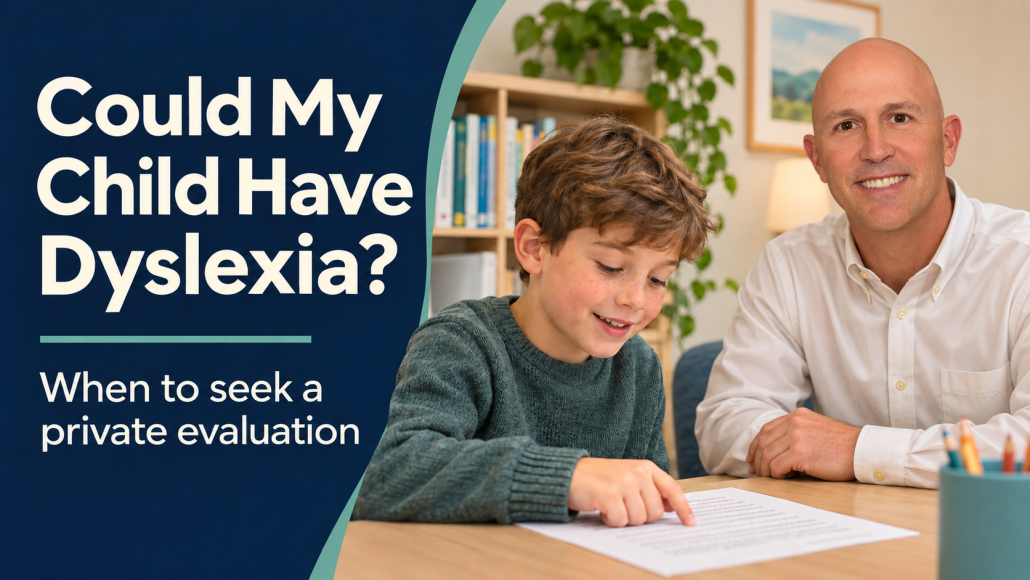
Your Child’s Reading Struggle Could Be Dyslexia
Your bright child can explain a story in wonderful detail after hearing it aloud. But when they try to read on their own, they get stuck on familiar words or guess after looking at the first letter. You’ve practiced together, and reading still takes more effort than you’d expect. If that pattern sounds familiar, a private school neuropsychological evaluation can help you understand where your child is getting stuck and what kind of instruction could help.
Look for a pattern over time
Dyslexia can affect how accurately or easily a child reads words and spells. A younger child may struggle to connect letters with sounds or blend those sounds into a word. An older child may read accurately but slowly, avoid unfamiliar words, or spell the same word several ways in one assignment. Take note if these difficulties persist even with reading instruction and practice. A family history of dyslexia or significant reading difficulties is also worth sharing with us.
What a private school neuropsychological evaluation can tell you
As a school neuropsychologist, I want to know what happens when a child meets a word they’ve never seen before. Can they use letter sounds and spelling patterns to figure it out? How much effort does that take? How does their understanding change when someone reads the same material aloud?
A comprehensive evaluation brings together your observations, school records, and direct testing of skills such as word reading, reading fluency, comprehension, and spelling. We also look at oral language, attention, and memory to understand what else might be contributing to the difficulty. The results can help clarify whether your child’s learning profile fits dyslexia and identify specific skills to teach. For example, a child who struggles to blend sounds into words needs a different starting point from a child who reads words accurately but very slowly.
What to ask before you schedule
In addition to being a school neuropsychologist, I’m also a certified Barton Dyslexia Testing Specialist as I worked with Susan Barton who created the Orton-Gillingham based Barton Reading and Spelling System. I know how to identify dyslexia and I’ve taught this to my associates. There is no one single test to identify dyslexia and many psychologists miss stealth dyslexia. Regardless of who you use for testing, ask the evaluator, “What specific dyslexia training have you done to test for dyslexia?How do you assess dyslexia in children my child’s age? Do you identify stealth dyslexia? Do you identify subtypes of dyslexia?” Once you schedule, gather a few reading or spelling samples, any school assessment results, and information about reading support your child has already received.
You can explain the visit to your child in simple terms. “We’re going to find out more about how to help you with your reading so your teacher knows how to help.” A clear explanation can give your child words for what they’ve been experiencing and give you a practical place to start.
Contact us to discuss your child and how we can help you understand your child’s struggles and get started using the best reading approach and methods to close the gap. My child had dyslexia so I understand what you are experiencing as my wife and I worked through this season as parents. A private school neuropsychological evaluation is an investment in your child’s future. Call (561) 625 4125 today.